
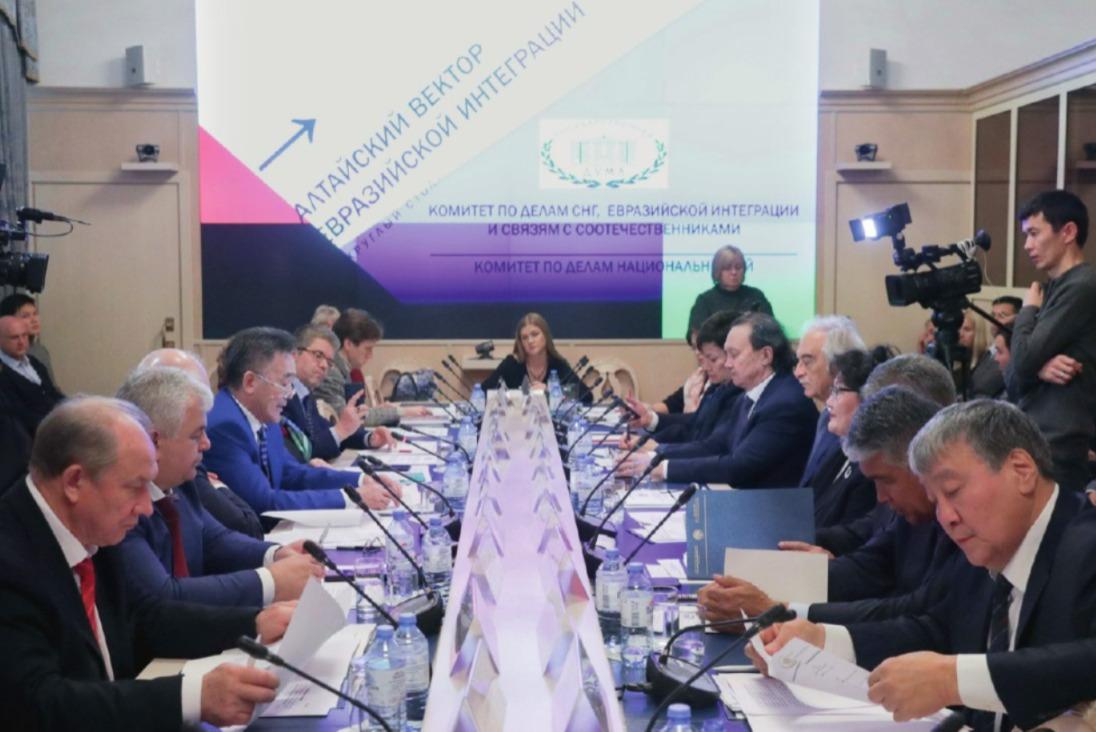
One of the most significant and symbolically profound events at the upcoming World Public Assembly will be the panel discussion titled “Altai – the Bell of Peace: The Junction of Civilizational Worlds.” This session will spotlight the Altai region as a unique geographical and spiritual territory that holds deep historical and cultural significance in the context of Eurasian civilization.
The panel will be moderated by Ivan Belekov, Adviser to the Head of the Altai Republic and Head of the Representative Office of the World Peoples Assembly in the Altai Republic. Belekov, who developed the concept for the session, emphasizes Altai’s special mission as a space of spiritual unity and a symbol of Eurasia’s polyethnic and poly-confessional identity.
“Altai is not only the guardian of the most ancient layers of Eurasian culture. This is the region of the planet where the dominant features of the Eurasian civilization are most vividly reflected: polyethnicity and poly-confessionalism. Orthodoxy, Islam, Buddhism, Tengrianism, Judaism, and other traditional movements are an integral part of Altai’s identity and heritage,” said Belekov.
The primary objective of the session is to strengthen Altai’s position as a platform for Eurasian-scale dialogue. It will focus on themes of intercultural cooperation, shared spiritual values, and the creation of a renewed ideology for Eurasian integration. Special attention will be given to the role of cultural diplomacy, historical examples of cooperation among peoples, and pressing modern issues such as information hygiene and globalization.
The significance of Altai as a spiritual and cultural crossroads has been echoed by many influential thinkers and scholars. Russian writer Grigory Grebenshchikov described Altai as “the bell of the Earth,” while anthropologist Theodore Schurr called it “a key point, a place where people have been coming and going for thousands and thousands of years.” Historian Lev Gumilev stated that “if Russia is saved, it will be only as a Eurasian power and through Eurasianism,” highlighting the broader geopolitical importance of the region. Artist and philosopher Nicholas Roerich referred to Altai as “the pearl of Siberia and Asia,” pointing to its destiny as a cultural center of global importance.
The session will bring together a diverse group of speakers from across Eurasia, including government officials, diplomats, academics, and cultural figures. Among the notable participants are:
- Amyr Argamakov, Senator of the Federation Council of the Federal Assembly of the Russian Federation (Russia)
- Zhyldyz Bakashova, Director of the National Historical Museum of the Kyrgyz Republic (Kyrgyzstan)
- Kubanychbek Bokantaev, Ambassador of the Kyrgyz Republic to the Russian Federation (Kyrgyzstan)
- Andrey Borisov, Theater Director, People’s Artist of the Russian Federation (Russia)
- Davaa Kan-ool, Chairman of the Supreme Khural of the Republic of Tyva (Russia)
- Anatoly Egorov, Doctor of History, researcher in comparative phraseology (Greece)
- Alexander Zhirkov, First Deputy Chairman of the State Assembly of the Republic of Sakha (Yakutia) (Russia)
- Konstantin Zatulin, Chairman of the State Duma Committee on CIS Affairs, Eurasian Integration and Relations with Compatriots (Russia)
- Leonid Kalashnikov, Chairman of the State Duma Committee on CIS Affairs, Eurasian Integration and Relations with Compatriots (Russia)
- Guzel Maitiinova, Director of the Center for Geopolitical Studies at the Russian-Tajik (Slavic) University (Tajikistan)
- Ezher Malchinov, First Deputy Chairman of the Government of the Altai Republic (Russia)
- Farid Mukhametshin, Chairman of the State Council of the Republic of Tatarstan (Russia)
- Grigory Ordzhonikidze, Envoy Extraordinary and Plenipotentiary of the 1st Class, Honored Worker of Culture of the Altai Republic (Russia)
- Edward Poletaev, Head of the Public Foundation “The World of Eurasia” (Kazakhstan)
- Ulziisaikhan Enkhtuvshin, Ambassador of Mongolia to the Russian Federation (Mongolia)
- Kholmakhmad Kholov, Professor at the Russian-Tajik (Slavic) University (Tajikistan)
Far more than a discussion of regional identity, the panel is envisioned as a new step toward establishing Altai as a spiritual and diplomatic foundation for the peaceful and creative coexistence of the peoples of Eurasia. As the world faces growing fragmentation and challenges to traditional values, the role of regions like Altai — rich in heritage, unity, and humanistic ideals — may become increasingly vital.
In this context, Altai will resonate not only as a geographical name but as a symbol of global hope and unity — the “bell” of a future built on cooperation, peace, and shared destiny.
About the Author




888starz o’yinchilarining shaxsiy va moliyaviy ma’lumotlarini himoya qilish uchun zamonaviy chora-tadbirlarni amalga oshiradi.
Bonus va aksiyalar 888starz foydalanuvchilarni jalb qilishda muhim rol o’ynaydi. Dastlabki depozit bonusi yangi a’zolarga katta imkoniyatlar ochadi.
888 стар https://888starz-uzb10.com/
O’yin tanlovi va provayderlar assortimenti 888starz-da keng. 888starz bir nechta yetakchi provayderlar bilan hamkorlik qilib, o’yin tanlovini kengaytiradi.
To’lovlar va mijozlarga xizmat ko’rsatish 888starz ning ustun tomonlaridan biridir. Mijozlarga xizmat ko’rsatish jamoasi tezkor javob berish bilan farqlanadi.