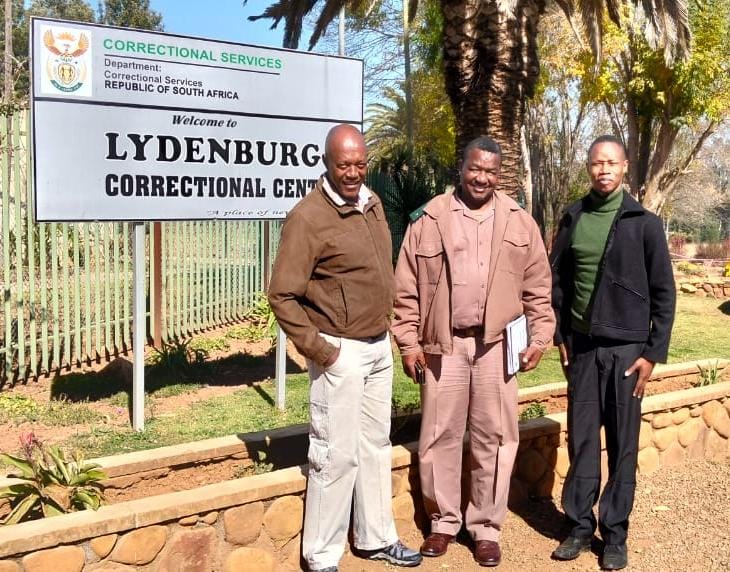
On 25 June 2025, the Commission for Gender Equality and the Department of Correctional Services in Mpumalanga, represented by Mr. Lucky Mabuza, joined forces with the Mordecai Ndlovu Foundation (MNF) to address the urgent challenge of parolee reintegration. The engagement, hosted at the Lyttenburg Correctional Precinct, marked a pivotal moment in the expansion of Project Revitalized—a flagship initiative committed to youth leadership, community development, and now, the structured reintegration of parolees into society.
The newly launched Parole Community Reintegration Program extends Project Revitalized’s reach to include former inmates—individuals often overlooked in national development efforts. Through entrepreneurship, civic education, and psychosocial support, the program offers a roadmap for parolees to transition into stable, purpose-driven lives.
“We are expanding Project Revitalized to places many avoid—prisons, forgotten communities, and margins of society—because justice must be local, lived, and led by those most affected,” said Mordecai Ndlovu, founder of MNF.
Currently active across Mpumalanga, Limpopo, Free State, KwaZulu-Natal, and Gauteng, Project Revitalized supports community-based NPOs, youth-led initiatives, and social entrepreneurs with training in governance, civic engagement, and enterprise development.
By integrating the Parole Community Reintegration Program, MNF aims to tackle pressing social issues such as gender-based violence (GBV), substance abuse, and recidivism, recognizing that many community organizations in its network are already engaged in youth rehabilitation, crime prevention, and community safety. The reintegration program empowers them with tools, frameworks, and institutional support to lead this work in collaboration with Correctional Services, municipalities, and civil society.
The Parole Community Reintegration Program is anchored in five core areas designed to ensure long-term, sustainable impact.
Civic education and behavioural change initiatives promote emotional healing, civic responsibility, and awareness of rights to address the root causes of violence and exclusion.
Entrepreneurship and micro-enterprise development training helps parolees acquire practical business skills, starter kits, and access to funding to build independent livelihoods.
Cross-sector collaboration brings together correctional services, youth offices, SEDA, NYDA, community NPOs, and traditional leaders to develop locally relevant reintegration solutions.
Community dialogue and restorative justice forums rebuild trust and mutual understanding between parolees and their communities, encouraging healing and accountability.
Mentorship and peer support networks connect parolees to trained facilitators, social workers, and rehabilitated former offenders who provide guidance and motivation throughout their reintegration journey.
“Many parolees exit correctional facilities only to face stigma, poverty, and unemployment, with little or no access to education or training,” said Mr. Lucky Mabuza of the Department of Correctional Services. This reality fuels cycles of exclusion and reoffending.
“You cannot expect rehabilitation when society offers rejection,” added Chaplain Garvin Nkosi.
“Young people are not problems to be solved—they are solutions waiting to be activated. Project Revitalized believes in purpose-driven inclusion—not as charity, but as strategy for safer, stronger communities,” said Ndlovu.
As part of the program’s rollout, youth-led NPOs in the Revitalized Cohort will be trained to deliver reintegration programs in townships and rural areas. Parolees will be eligible for micro-grants and business start-up kits aligned with their skills and interests. Monitoring and support systems will be co-designed with parole officers, mentors, and community leaders to ensure sustained impact.
Pilot programs will begin in Mpumalanga (Lyttenburg), the Free State, and Sebokeng, with support from key stakeholders in civic and justice sectors.
This initiative is more than a program—it is a movement for restorative justice, youth-led leadership, and economic dignity. But it cannot succeed in isolation.
The MNF invites Correctional Services to collaborate on skills development and behavioural change programming. Local governments and funders are called to invest in training and enterprise support. NPOs, faith-based organisations, and social workers are encouraged to take leadership roles in reintegration implementation. Businesses are urged to adopt second-chance hiring policies and inclusive procurement strategies.
“Let us not simply release people from prison. Let us release them into hope, structure, and purpose,” concluded Ndlovu.
Join the Reintegration Movement
To support, partner with, or pilot the Parole Community Reintegration Program under Project Revitalized, contact:
info@mn-f.org
www.mn-f.org
+27 10 786 0000
Together, we can build a South Africa where no one is left behind.
About the Author