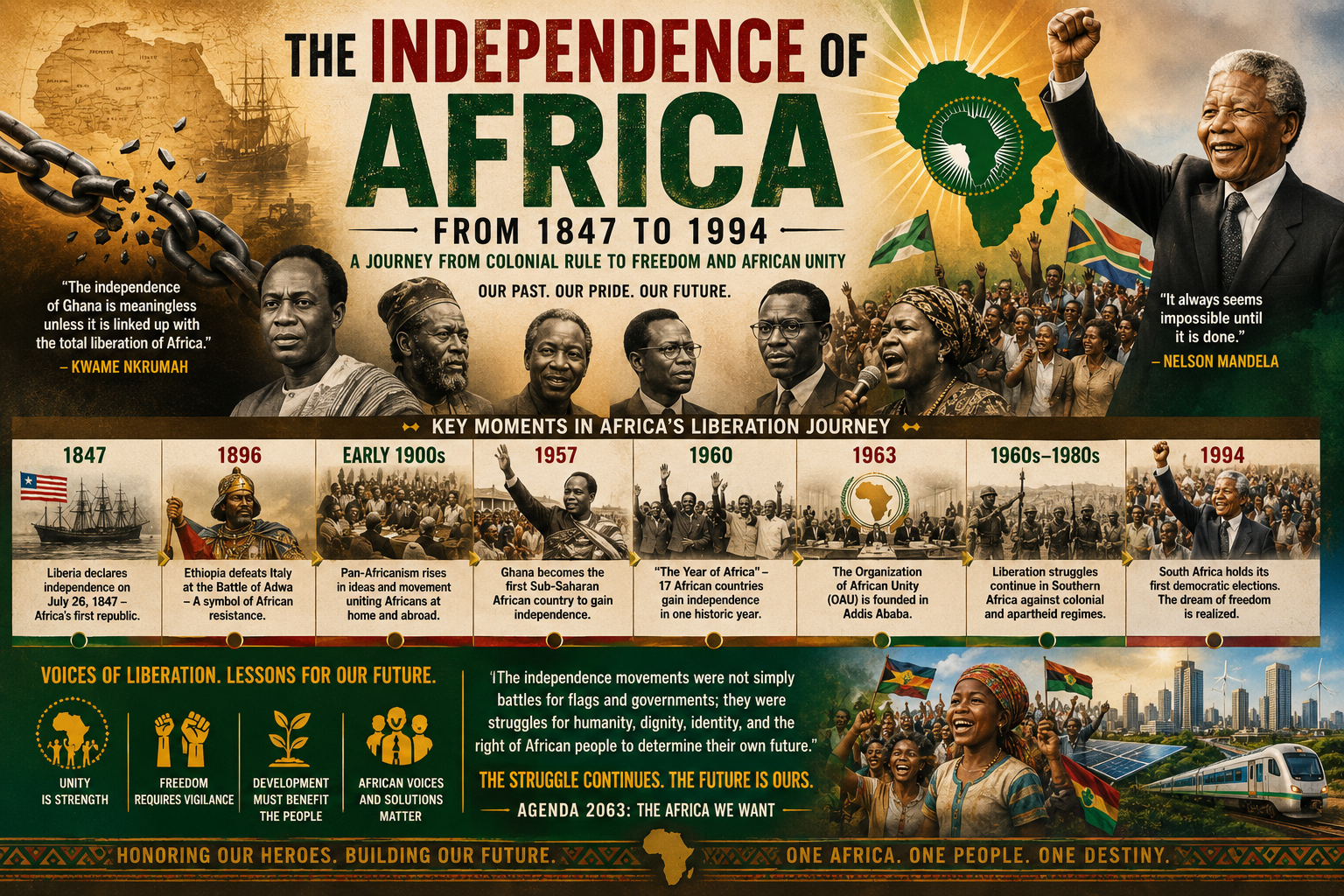
A Journey from Colonial Rule to Freedom and African Unity
Africa’s road to independence is one of the greatest political and human liberation stories in world history. From the declaration of independence by Liberia in 1847 to the end of apartheid in South Africa in 1994, African nations fought against colonialism, exploitation, racism, and oppression to reclaim their sovereignty, dignity, and identity.
The struggle for independence was not only political it was cultural, economic, intellectual, and spiritual. It united generations of freedom fighters, workers, students, women, religious leaders, artists, and ordinary citizens across the continent.
The Beginning of African Independence (1847)
The modern history of African independence began with Liberia, which declared independence on 26 July 1847. Founded by formerly enslaved Africans from the United States, Liberia became Africa’s first modern republic governed by Black Africans.
For decades afterward, however, most of Africa remained under European colonial control. European powers including Britain, France, Portugal, Belgium, Germany, Italy, and Spain occupied African territories, extracted natural resources, and imposed foreign political systems.
The “Scramble for Africa” during the late 19th century intensified colonial domination. African societies lost land, economic power, and political freedom, while colonial borders divided ethnic and cultural communities.
Colonialism and Resistance
Despite colonial occupation, Africans continuously resisted foreign rule. Resistance movements emerged across the continent through armed struggle, political activism, labor movements, religious organizations, and cultural resistance.
Early African resistance leaders included:
- Samori Touré in West Africa
- Menelik II of Ethiopia
- Yaa Asantewaa of the Ashanti Kingdom
- Abdelkader in Algeria
- Cetshwayo kaMpande of the Zulu Kingdom
Ethiopia became a major symbol of African resistance after defeating Italy at the Battle of Adwa in 1896, making it one of the few African nations to successfully resist colonization.
The Rise of Pan-Africanism
During the early 20th century, Pan-Africanism emerged as a global movement calling for African unity, self-determination, and liberation from colonial rule.
Pan-African thinkers and leaders such as:
- Marcus Garvey
- W.E.B. Du Bois
- Kwame Nkrumah
- Julius Nyerere
- Jomo Kenyatta
- Patrice Lumumba
inspired Africans to fight for political freedom and continental solidarity.
The Pan-African movement emphasized:
- African identity and pride
- Economic self-reliance
- Unity among African nations
- Resistance against racism and imperialism
These ideas became central to the independence struggles that followed.
The Wave of Independence (1950s–1970s)
After World War II, African nationalism gained momentum. Returning African soldiers, educated elites, labor unions, and youth movements intensified demands for independence.
Ghana Leads the Way
In 1957, Ghana became the first sub-Saharan African country to gain independence from colonial rule under the leadership of Kwame Nkrumah.
Nkrumah famously declared:
“The independence of Ghana is meaningless unless it is linked up with the total liberation of Africa.”
Ghana’s independence inspired liberation movements across the continent.
1960: The Year of Africa
The year 1960 became known as “The Year of Africa” because 17 African countries gained independence in a single year, including:
- Nigeria
- Senegal
- Mali
- Congo
- Somalia
- Madagascar
- Niger
- Chad
This marked a turning point in global politics and accelerated the collapse of colonial empires in Africa.
Liberation Struggles in Southern Africa
While many African countries gained independence peacefully, Southern Africa experienced some of the most difficult and violent liberation struggles due to settler colonialism and apartheid systems.
Countries such as:
- Angola
- Mozambique
- Namibia
- Zimbabwe
- South Africa
faced armed conflicts against colonial and minority-rule governments.
Freedom movements included:
- ANC (African National Congress)
- SWAPO
- MPLA
- FRELIMO
- ZANU and ZAPU
These movements received support from African nations, liberation organizations, and international solidarity campaigns.
The Organization of African Unity (OAU)
In 1963, African leaders established the Organization of African Unity (OAU) in Addis Ababa, Ethiopia.
The OAU aimed to:
- Support liberation movements
- Promote African unity
- Defend sovereignty
- Fight colonialism and apartheid
- Encourage cooperation among African states
The organization later evolved into the African Union (AU), which continues to promote Agenda 2063 and continental development.
The Fall of Apartheid and the Birth of Democratic South Africa
One of the final chapters of African liberation was the defeat of apartheid in South Africa.
For decades, Black South Africans endured racial segregation, political exclusion, forced removals, and economic oppression under apartheid rule.
Leaders such as:
- Nelson Mandela
- Oliver Tambo
- Steve Biko
- Walter Sisulu
- Albertina Sisulu
- Chris Hani
became global symbols of resistance and freedom.
After years of struggle, international sanctions, and negotiations, South Africa held its first democratic elections in 1994.
Nelson Mandela became the country’s first democratically elected Black president, symbolizing the triumph of democracy, reconciliation, and African liberation.
The Legacy of African Independence
African independence transformed global history. The liberation of African nations:
- Ended formal colonial rule
- Restored African political sovereignty
- Inspired civil rights movements worldwide
- Advanced Black consciousness and Pan-Africanism
- Strengthened cultural identity and pride
However, independence also brought new challenges, including:
- Economic inequality
- Political instability
- Corruption
- Debt dependency
- Neo-colonial influence
- Youth unemployment
Today, African nations continue working toward the vision of Agenda 2063 — “The Africa We Want.”
Conclusion
From Liberia’s independence in 1847 to South Africa’s democratic breakthrough in 1994, Africa’s liberation journey reflects courage, sacrifice, resilience, and unity.
The independence movements were not simply battles for flags and governments; they were struggles for humanity, dignity, identity, and the right of African people to determine their own future.
As Africa continues to rise in the 21st century, the lessons of liberation remain relevant:
- Unity is strength.
- Freedom requires vigilance.
- Development must benefit the people.
- African voices and solutions matter.
The story of African independence is not only history, it is a living legacy that continues to shape the continent’s future and inspire generations across the world.
About the Author