By Mzansi Mail News & African Youth Radio
Africa’s development story is increasingly being shaped not only by governments and multinational institutions, but also by African entrepreneurs, philanthropists, cultural leaders and social innovators who are investing in people, institutions and ideas.
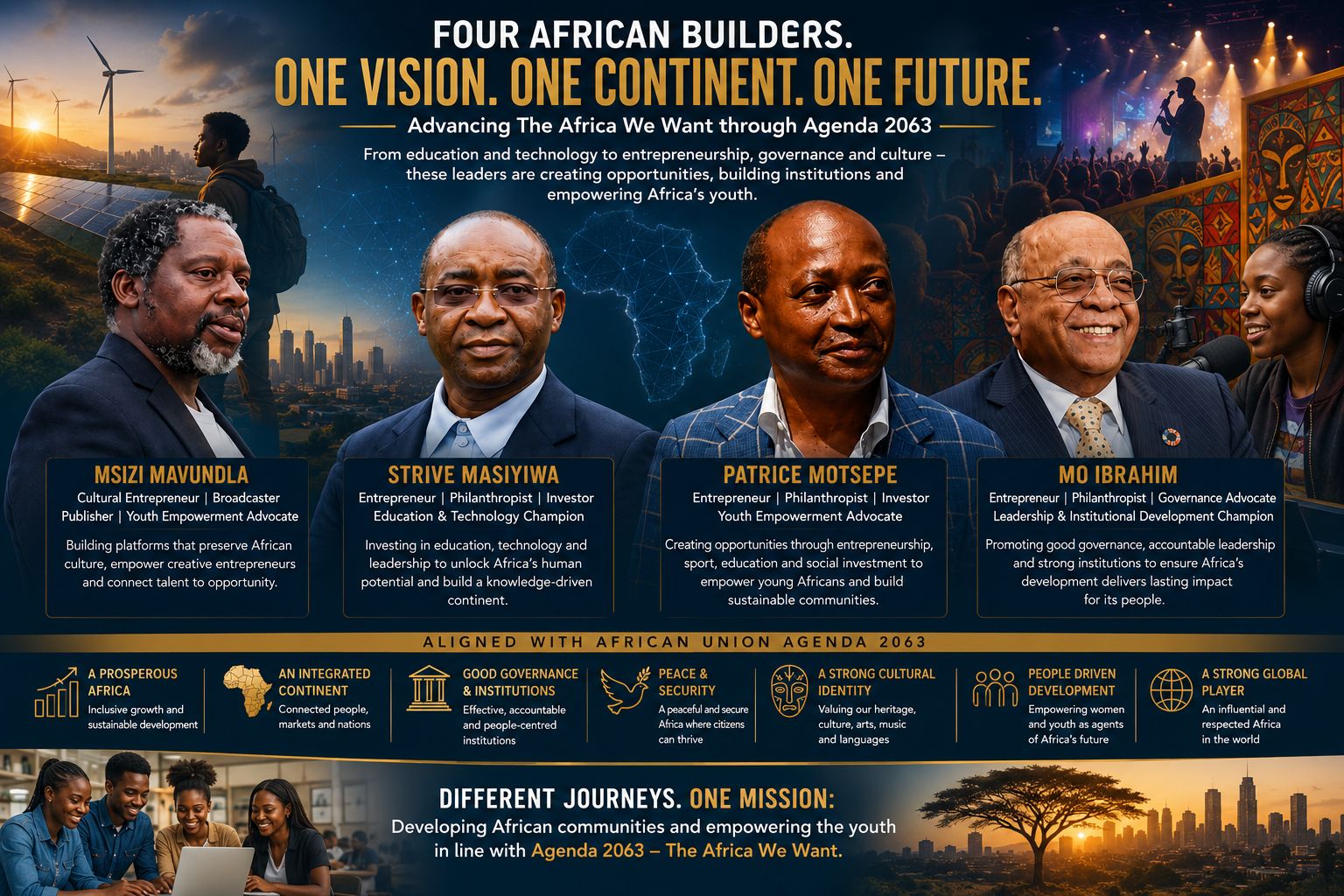
Among the individuals whose work provides important examples of African-led development are Zimbabwean entrepreneur and philanthropist Strive Masiyiwa, South African businessman and philanthropist Patrice Motsepe, Sudanese-British entrepreneur and philanthropist Mo Ibrahim, and South African cultural entrepreneur and media practitioner Msizi Mavundla.
Their industries and approaches are different. Masiyiwa built a major telecommunications and technology business; Motsepe built a diversified business empire while developing extensive philanthropic initiatives; Ibrahim built a telecommunications company before establishing a foundation focused on African leadership and governance; while Mavundla has concentrated his efforts on media, broadcasting, culture, indigenous music, creative entrepreneurship and youth development.
Yet there is a common thread connecting their work: the belief that Africa’s greatest resource is its people, particularly its young people, and that sustainable development requires African institutions capable of turning talent into opportunity.
That philosophy strongly resonates with the African Union’s Agenda 2063: The Africa We Want, the continent’s long-term framework for inclusive and sustainable development. Agenda 2063 identifies priorities including education and skills, employment, youth empowerment, capable institutions, entrepreneurship, culture and creative industries, technological innovation and African integration.
Agenda 2063: From Vision to Action
Agenda 2063 is more than a political declaration. The African Union describes it as Africa’s blueprint and master plan for transforming the continent into a global powerhouse while advancing Pan-Africanism, self-determination, inclusive growth and collective prosperity.
Its seven aspirations include a prosperous Africa based on inclusive growth; an integrated continent; good governance; peace and security; a strong African cultural identity; people-driven development centred on women and youth; and an Africa that is a strong and influential global player.
This makes youth development particularly important. The AU’s current implementation framework calls for stronger measures to reduce youth unemployment and increase youth-owned businesses, including technical and financial support for young entrepreneurs.
Against that continental framework, the work of these four African builders offers four different but complementary models of empowerment: human capital, entrepreneurship, leadership and culture.
Strive Masiyiwa: Building Human Capital Through Education and Technology
Strive Masiyiwa’s contribution to African development extends beyond his achievements in business and telecommunications. Through the Higherlife Foundation and related philanthropic initiatives developed with his family, education and human-capital development have become central elements of his social-impact work.
Higherlife Foundation has supported large numbers of African learners through scholarships and education programmes, while programmes such as the Joshua Nkomo Scholarship have placed particular emphasis on developing academically gifted young people and strengthening Africa’s STEM talent pipeline. The foundation’s Moshoeshoe I Scholarship in Lesotho, for example, supports academically gifted students pursuing STEM careers while incorporating leadership development and community engagement.
Masiyiwa’s support has also extended to initiatives aimed at developing African student leaders. A partnership between Higherlife Foundation and Yale supported the Yale Young African Scholars programme, designed to prepare high-achieving African secondary-school students for university and future leadership.
The broader philosophy is significant. Africa cannot build competitive economies without investing in its human capital. Education, technology, entrepreneurship and leadership development are therefore not separate challenges; they are interconnected components of development.
That approach aligns closely with Agenda 2063’s emphasis on an education and skills revolution driven by science, technology and innovation, as well as its ambition for an empowered African youth.
Patrice Motsepe: Entrepreneurship, Social Enterprise, Sport and Opportunity
South Africa’s Patrice Motsepe represents another model of African empowerment: using entrepreneurship and philanthropy to expand opportunities for young people and communities.
Through the Motsepe Foundation, initiatives have focused on education, entrepreneurship, sport, music and social development.
One particularly relevant example is the Golden Circle initiative, which has supported youth-led businesses through capital, capacity building, mentorship and exposure to investors and professional experts. The foundation committed R5 million over five years toward supporting 25 South African youth-led start-ups, with the programme designed to help high-impact entrepreneurs develop and scale their ventures.
This is particularly relevant to Africa’s youth unemployment challenge because it moves beyond the idea that young people should simply become job seekers. It recognises young Africans as potential business owners, employers, innovators and social entrepreneurs.
The Motsepe Foundation’s work in sports and music provides another important dimension. Its programmes seek to nurture young people’s aspirations in cultural sectors, support platforms that showcase talent and provide mentorship and coaching. Its sports initiatives include the Kay Motsepe Schools Cup, which provides opportunities for school learners to develop sporting talent and compete nationally.
The foundation has also highlighted the importance of STEM education and scholarships in developing professionals who can contribute to improved community services and living standards.
The underlying principle is consistent with Agenda 2063: development must create pathways through which young Africans can turn talent, knowledge and ideas into economic and social value.
Mo Ibrahim: Leadership, Governance and an Accountable Africa
Mo Ibrahim brings a different but equally important dimension to African development.
After building a successful telecommunications business, Ibrahim established the Mo Ibrahim Foundation, which focuses on good governance and leadership in Africa.
Its programmes have included the Ibrahim Index of African Governance, the Ibrahim Prize for Achievement in African Leadership, the Ibrahim Forum and leadership-capacity programmes such as the Ibrahim Leadership Fellowships and scholarship initiatives. These programmes seek to strengthen African leadership, promote accountability and support the development of future leaders.
This is crucial because economic development without capable institutions can struggle to produce lasting transformation.
Africa needs entrepreneurs, scientists, artists and innovators but it also needs ethical and capable leadership capable of creating institutions that serve citizens.
The Foundation’s work has consistently emphasised the importance of listening to African youth, developing human capital and creating opportunities for young Africans to participate in shaping the continent’s future.
That directly connects with Agenda 2063 Aspiration 3, which calls for capable institutions and transformative leadership, and Aspiration 6, which envisions an Africa whose development is people-driven and centred on the potential of its people, especially women and youth.
Msizi Mavundla: Culture, Media and the Creative Economy as Development Tools
While Masiyiwa, Motsepe and Ibrahim operate at enormous continental and international scales, Msizi Mavundla represents an emerging model of grassroots African institution-building through culture, media and the creative economy.
Mavundla’s career has developed across broadcasting, music, publishing, entrepreneurship, events and cultural development. His initiatives include Sounds of Azania Cultural & Creative Incubator, Sounds of Azania Radio, Mzansi Mail News, African Youth Radio, Urban Sounds Agency, Rappers Without Borders and the Choral Indigenous Music Awards (CIMA).
Through Sounds of Azania and CIMA, his work places African cultural heritage at the centre of economic and social development.
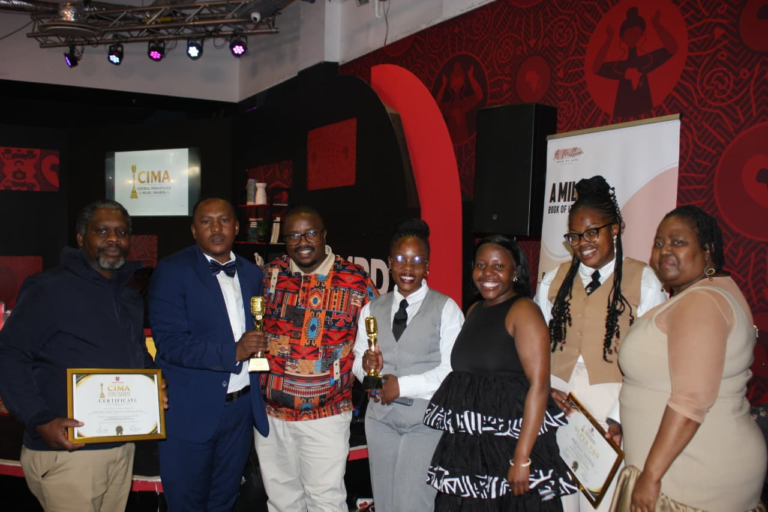
CIMA was established as a platform to preserve and promote indigenous choral music, recognise established and emerging talent, encourage innovation within traditional and choral genres and create opportunities for communities to celebrate their cultural heritage.
This is more significant than an awards ceremony.
Africa’s creative economy represents a major opportunity for young people. Music, broadcasting, publishing, film, fashion, design, digital media, cultural tourism and live entertainment can create employment while simultaneously strengthening cultural identity.
Mavundla’s wider media and cultural ecosystem reflects this philosophy. His work has included the establishment of media platforms, radio stations, publishing initiatives and creative-industry organisations designed to provide platforms for African voices and talent.
In this respect, Mavundla’s approach speaks directly to Agenda 2063’s cultural renaissance agenda, which recognises cultural heritage, creative arts and businesses as important components of Africa’s development. The AU specifically identifies the Great African Museum project as part of its flagship efforts to promote African heritage, culture, arts, music and languages.
Four Paths, One African Development Agenda
Although their careers differ, the four men illustrate four important dimensions of African development.
Masiyiwa represents human capital and technological opportunity.
His education and scholarship initiatives demonstrate the importance of investing in young Africans before expecting them to transform their communities.
Motsepe represents entrepreneurship and social investment.
His initiatives demonstrate how capital, mentorship, sport, music and enterprise development can create pathways for young people to participate in the economy.
Ibrahim represents governance and leadership.
His work demonstrates that Africa’s transformation requires accountable institutions and leaders capable of serving the public interest.
Mavundla represents culture, media and creative entrepreneurship.
His work demonstrates that African culture is not simply something to preserve in museums it can become a living economic sector capable of creating careers, businesses and platforms for young people.
Together, these approaches correspond with several core priorities identified by the African Union: human-capital development, youth employment, entrepreneurship, capable institutions, technology, culture, arts and sports.
The Missing Link: Connecting Culture to the Economy
One of the most important lessons from these examples is that empowerment should not happen in isolation.
A young musician needs more than talent.
They need education, business knowledge, access to markets, intellectual-property awareness, technology, media exposure, financial literacy, professional networks and opportunities to perform.
A young entrepreneur needs more than capital.
They need mentorship, skills, market access, technology and an ecosystem capable of helping them scale.
A young leader needs more than a title.
They need knowledge, ethical foundations, institutional experience and opportunities to participate in decision-making.
This is where the creative economy can become an important bridge between culture and economic development.
Building the African Institution of Tomorrow
The AU’s vision is ultimately about building an Africa capable of creating prosperity for its people. Its transformational outcomes include improved living standards, inclusive economies, empowered youth, stronger institutions and preservation of African cultural identity.
The work of Masiyiwa, Motsepe, Ibrahim and Mavundla demonstrates that there is no single formula for achieving this vision.
One invests in education and technology.
Another invests in entrepreneurship, sport and social enterprise.
Another invests in governance and leadership.
Another invests in culture, media and creative industries.
The common denominator is institution building.
Africa does not only need successful individuals. It needs successful institutions that continue creating opportunities long after their founders have moved on.
That may ultimately be the most important lesson for Africa’s young generation.
The question should not simply be, “How can I become successful?”
It should be:
“What can I build that will make success possible for thousands of other Africans?”
That is the spirit of Agenda 2063.
And it is a question that today’s African entrepreneurs, philanthropists, cultural leaders and young innovators must continue answering not only for themselves, but for the generations that will inherit the Africa of 2063.
The Africa We Want
For Mzansi Mail News and African Youth Radio, the stories of Strive Masiyiwa, Patrice Motsepe, Mo Ibrahim and Msizi Mavundla offer four different perspectives on one shared African ambition: to transform talent into opportunity, culture into economic value, education into empowerment, entrepreneurship into employment and leadership into lasting institutions.
Their journeys also demonstrate that African development is not the responsibility of governments alone. The private sector, civil society, philanthropists, educators, cultural practitioners, media organisations and most importantly young Africans all have a role to play.
Agenda 2063 provides the continental vision.
The challenge for this generation is to build the institutions, businesses, cultural platforms and human-capital systems capable of making that vision real.
The Africa We Want will ultimately be built by Africans who choose not only to participate in the future, but to create it.
About the Author